Some vintage never goes out of style because it was never about style in the first place. Work jackets made for railway workers, coats made for workshops, smocks made for fishermen and trousers made for soldiers: European clothes built to be used every day, for decades. Today they are some of the most searched, saved and talked-about pieces in vintage. Here is the hit list, and how to tell a good one when you find it.
The pieces everyone is hunting
- The French work jacket, in blue cotton twill or moleskin.
- Moleskin, the dense brushed cotton that fades like nothing else.
- Railway, workshop and kitchen coats: long, plain and very wearable.
- The fisherman smock, a canvas pullover from the Atlantic coast.
- European army surplus from France, Switzerland, Sweden, Italy and beyond.
- Herringbone and geometric knits, the heart of the “grandpa core” look.
1. The French work jacket
The veste de travail, or “bleu de travail”, is the piece that started it all: a straight, boxy jacket with a small collar, three patch pockets and a button front, worn by mechanics, farmers and factory workers across France for most of the 20th century. It is the European cousin of the American chore coat, but softer, shorter in the body and almost always in that famous French blue.
What collectors talk about most is the fade. Years of washing turn the deep indigo-blue into pale sky blue, darker under the collar and pockets. A jacket with an even, natural fade and a few honest repairs is worth more to many people than a perfect one.
Names to look for on the label: Adolphe Lafont, Le Laboureur, Vetra, Le Mont Saint Michel and many small regional makers. A “Sanfor” or “Sanforisé” mark means the cotton was pre-shrunk.
2. Moleskin
Despite the name, moleskin is cotton: a very dense, tightly woven fabric that is brushed on one side until it feels like suede. It was the winter work fabric, warm and almost windproof. Blue moleskin is the classic; black moleskin is rarer and much searched for. Older pieces from the 1950s and 60s often have metal buttons and a thicker, stiffer hand.
3. Railway, workshop and kitchen coats
The work jacket has relatives that are just as wanted. Railway jackets worn by French railway staff, long shop coats (atelier coats) in grey, blue or white cotton that look great open over a knit, and double-breasted chef jackets in thick white cotton. They are simple, well cut and often cheaper than a work jacket, which makes them a smart first find.
4. The fisherman smock
A loose pullover in heavy cotton canvas with a half placket or a small collar, sometimes with a chest pocket, made to be thrown over a sweater on a boat. Faded navy, ecru and brick red are the favourite colours. It is the perfect layer for spring and autumn, and it looks just as good with a striped Breton top underneath.
5. European army surplus
Military clothing from European armies is a world of its own, and much more varied than the usual American field jacket. Some of the most searched pieces:
- France: the F2 field jacket and the M-47 trousers, with their big side pockets.
- Switzerland: denim work trousers and jackets in a rare grey-green denim.
- Sweden: sturdy cotton field jackets and white snow parkas.
- Italy and the Czech Republic: chino jackets and stand-collar mechanic jackets.
- Belgium: the “jigsaw” camouflage, loved for its unusual pattern.
Army sizes follow their own systems (a Swedish C48 or a Swiss 50/72, for example), so always go by the real measurements.
6. Herringbone and geometric knits
Herringbone cotton work jackets, often made in Germany, and the bold all-over geometric knits made in Italy in the 70s, 80s and 90s are the heart of the “grandpa core” look: cosy, a little eccentric and impossible to find new. Look for “Made in Italy” on knits, wool or wool-blend yarns and patterns that still feel bright.
How to spot a good one
- The label: country of origin, maker, “Sanfor”, or no label at all on the oldest pieces.
- The fabric: heavy and dense is good; thin and shiny usually means newer.
- The buttons: metal, riveted or old corozo buttons are a good sign.
- The fade and the repairs: even fading and careful old repairs add character; holes in seams are harder to fix.
- The size: European sizes (46, 48, 50…) and army sizes are confusing. Compare the flat measurements with a jacket you already own.
From our rail
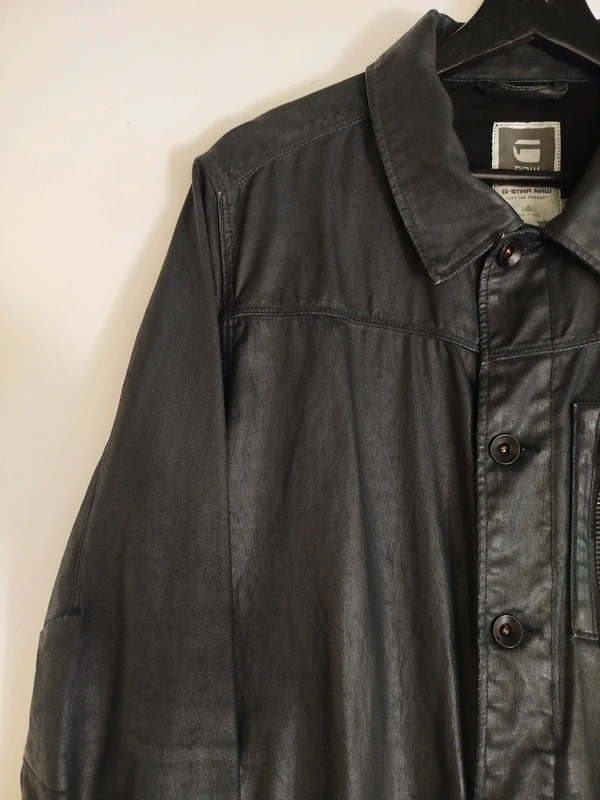
Our shop is small and every piece is one of a kind, but the same spirit runs through it: the G-Star RAW waxed denim jacket with its workwear pockets, a 90s grandpa core herringbone polo by Trapo’s, a pure indigo cotton cable knit that is made to fade, and a Burberrys’ trench coat, made in England. Have a look before someone else does.